DAFDepth Anchoring Fine-tuning
Adapts a pretrained VGGT-Ω backbone from relative to metric depth, using sparse LiDAR plus a frozen teacher for the pixels LiDAR misses. The geometry is then frozen, so motion learning cannot trade depth for motion.
Under review · anonymous authors
Feed-Forward Metric 4D Gaussian Splatting for Surround-View Driving Scenes
● Demo on Waymo validation clips: our renderings and metric depth for all five cameras, side by side with STORM and DGGT, and our depth of the five cameras fused into one 3D scene.Baselines receive the same 20 frames as context.
Abstract
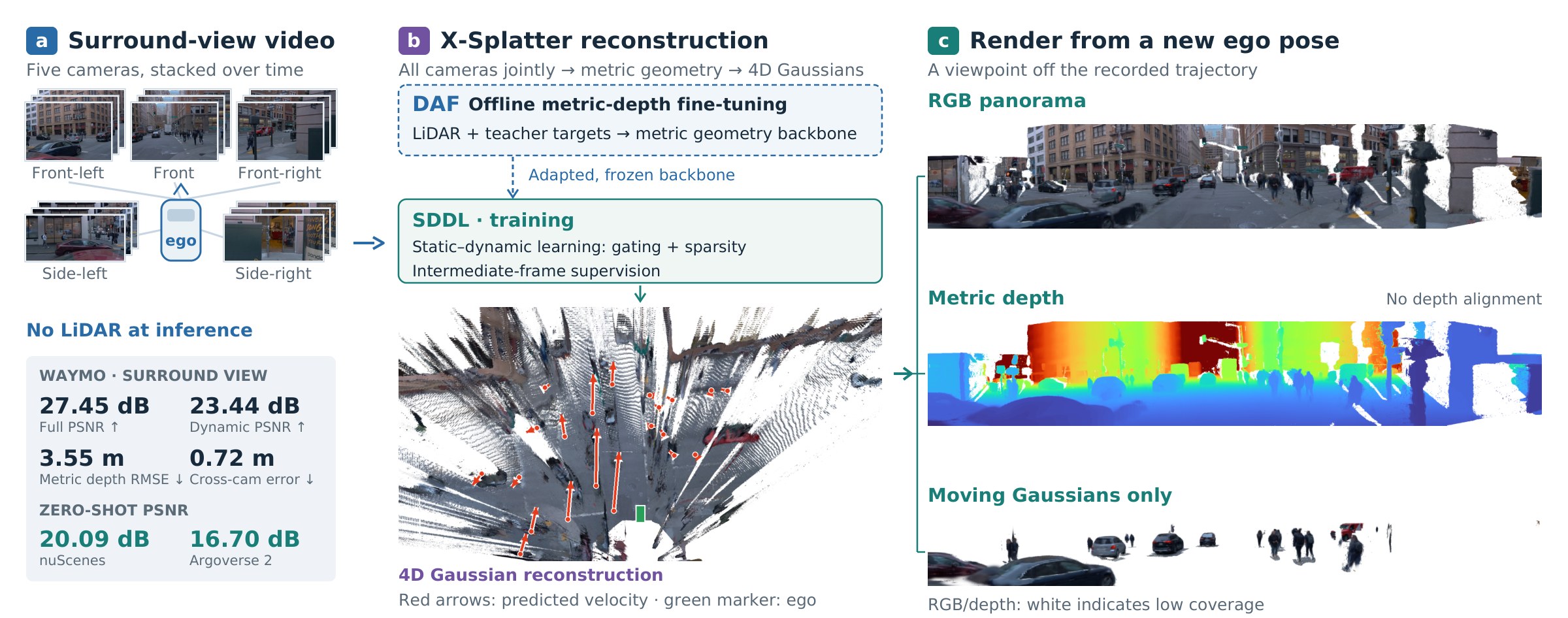
Feed-forward scene reconstruction supports scalable simulation and world modeling for autonomous driving. We present X-Splatter, a surround-view, feed-forward 4D Gaussian Splatting (4DGS) framework that processes all surround cameras jointly on a VGGT-Ω backbone, with cross-camera attention throughout the network. It introduces two key components: Depth Anchoring Fine-tuning (DAF), which shifts geometry from relative to metric space, and Static–Dynamic Decomposition Learning (SDDL), which combines dynamic gating, static-promoting regularization, and intermediate-frame supervision to alleviate static–dynamic conflation and enhance motion learning. Following LiDAR-supervised depth adaptation, X-Splatter uses self-supervised motion learning, without bounding boxes, tracklets, or optical-flow labels.
Trained and evaluated on all surrounding views, including the side views that share the least content with the front camera, X-Splatter achieves the best full-image and dynamic-region novel-view synthesis and the lowest metric-depth RMSE among the evaluated baselines on the Waymo Open Dataset. It also achieves the lowest cross-view 3D error, indicating better geometric agreement across adjacent cameras. The same model generalizes zero-shot to nuScenes and Argoverse 2, outperforming the evaluated baselines in rendering and metric-depth accuracy on both.
Method
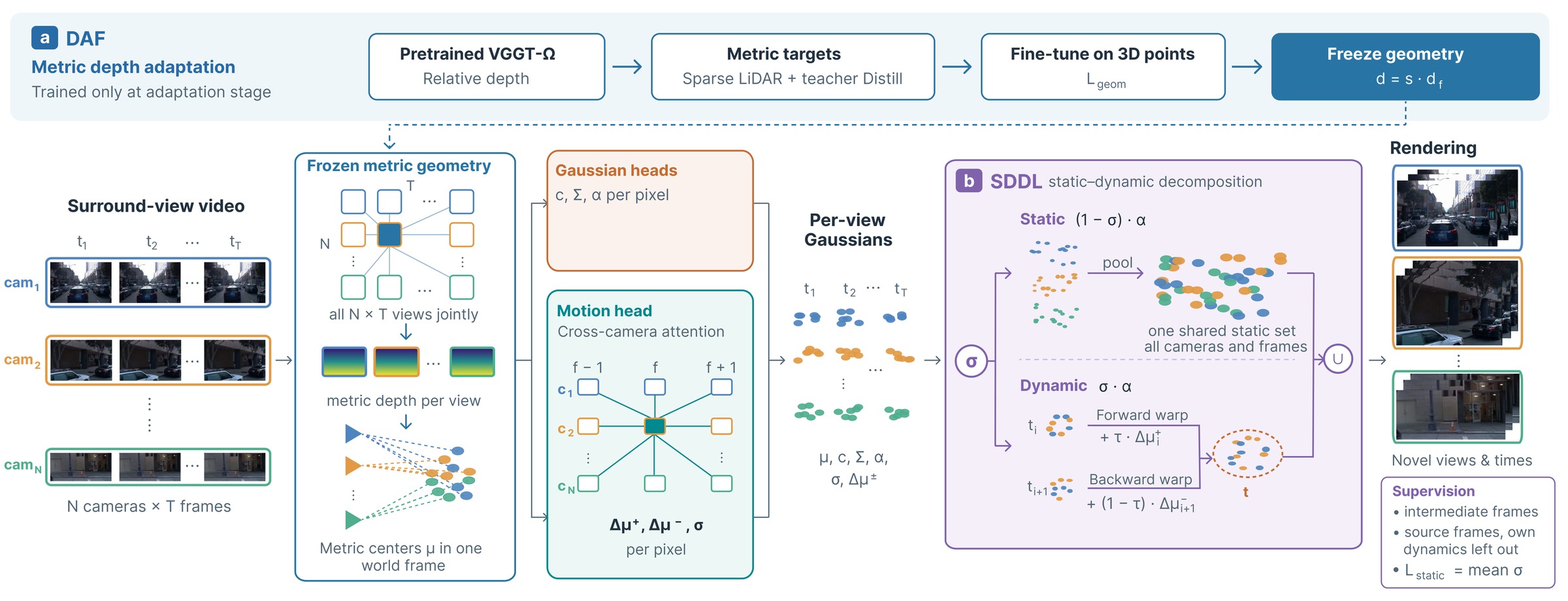
Adapts a pretrained VGGT-Ω backbone from relative to metric depth, using sparse LiDAR plus a frozen teacher for the pixels LiDAR misses. The geometry is then frozen, so motion learning cannot trade depth for motion.
The frozen backbone attends over all cameras and frames at once, and the motion head lets each camera attend to all cameras at the neighboring frames. Processing cameras separately instead nearly triples the cross-camera 3D error (0.72 → 2.10 m).
A per-Gaussian gate splits shared static content from velocity-warped dynamic content. Static-promoting regularization and intermediate-frame supervision stop the model from explaining the scene with motion it does not have, without boxes, tracks, or flow labels.
Videos
Short loops cut from the demo above. Every clip is a two-second Waymo validation sequence at 10 Hz; the baselines are given all 20 frames as context.
Rendered novel-view and novel-time videos are coming soon.
Results
Every method is scored across all five Waymo cameras, including the side views that share the least content with the front camera. Depth is the rendered depth, scored in meters directly (metric) or after a per-clip scale-and-shift fit (affine-aligned).
| Method | Input cams | Full image | Dynamic region | Depth RMSE (m) ↓ | |||
|---|---|---|---|---|---|---|---|
| PSNR ↑ | SSIM ↑ | PSNR ↑ | SSIM ↑ | metric | affine-aligned | ||
| STORM | 5 | 22.66 | 0.680 | 20.82 | 0.524 | 6.67 | 5.46 |
| STORM | 1 | 21.65 | 0.632 | 19.90 | 0.466 | 8.24 | 6.29 |
| DGGT† | 1 | 20.28 | 0.576 | 18.95 | 0.447 | 17.62 | 5.03 |
| X-Splatter (front-camera input) | 1 | 24.60 | 0.720 | 21.44 | 0.577 | 5.40 | 4.27 |
| X-Splatter | 5 | 27.45 | 0.814 | 23.44 | 0.686 | 3.55 | 3.33 |
| X-Splatter + weak sup. | 5 | 27.48 | 0.814 | 23.96 | 0.709 | 3.53 | 3.32 |
All rows are scored on all five cameras; single-camera-input models are run once per camera. The released STORM and DGGT checkpoints were trained on the three front-facing cameras and not retrained for five-camera input. †DGGT predicts relative geometry and aligns its camera trajectory to ground-truth poses for rendering. “Weak sup.” adds a region-weighted RGB loss on moving-object masks from 3D boxes. Top two per column in bold.
Qualitative
Held-out front-camera views of clips selected by the authors. Waymo is in domain; nuScenes and Argoverse 2 are zero-shot, with no training on either dataset. Matched boxes and insets mark the same region in every method. Depth uses a shared 0–80 m colormap; white marks sky and pixels without LiDAR or a rendered value.
Geometry
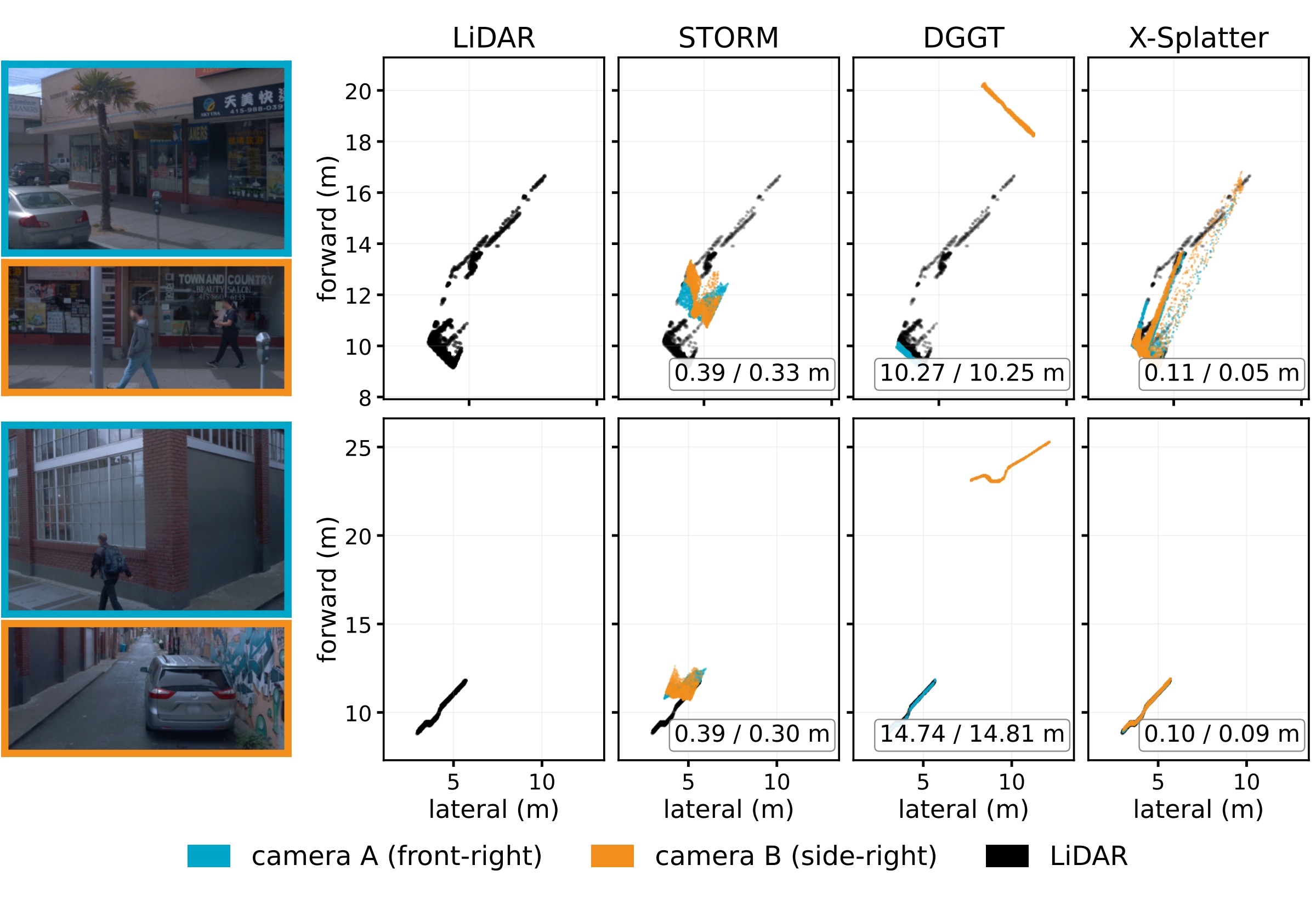
Where two cameras overlap, a consistent reconstruction should place the same surface at the same 3D position from both. Each panel unprojects the two cameras' own depth over their shared field of view, seen from above; LiDAR is in black. Over 397 clips from 202 Waymo validation scenes, X-Splatter places the same surface 0.72 m apart on average, against 2.51 m for STORM.
Generalization
The Waymo-trained model is evaluated on nuScenes (six cameras) and Argoverse 2 (seven cameras) with no further training, over 100 scenes per dataset.
| Method | Waymo → nuScenes | Waymo → Argoverse 2 | ||||
|---|---|---|---|---|---|---|
| PSNR ↑ | Depth RMSE (m) ↓ | PSNR ↑ | Depth RMSE (m) ↓ | |||
| metric | affine-aligned | metric | affine-aligned | |||
| All cameras | ||||||
| STORM | 17.98 | 10.92 | 8.51 | 16.21 | 18.65 | 13.28 |
| DGGT | 18.26 | 9.79 | 6.36 | 16.03 | 36.49 | 10.65 |
| X-Splatter | 20.09 | 8.38 | 6.76 | 16.70 | 13.53 | 11.84 |
| X-Splatter + weak sup. | 19.91 | 8.38 | 6.80 | 16.75 | 13.37 | 11.64 |
| Front camera | ||||||
| STORM | 19.08 | 9.62 | 8.50 | 17.67 | 19.93 | 16.54 |
| DGGT | 22.27 | 10.33 | 6.35 | 16.27 | 86.08 | 13.30 |
| X-Splatter | 23.00 | 8.61 | 6.60 | 17.91 | 16.63 | 13.54 |
| X-Splatter + weak sup. | 22.80 | 8.58 | 6.60 | 17.82 | 16.43 | 13.01 |
Best per column within each camera block in bold, ties included.
Citation
@article{xsplatter2026,
  title   = {X-Splatter: Feed-Forward Metric 4D Gaussian Splatting
             for Surround-View Driving Scenes},
  author  = {Anonymous},
  journal = {Under review},
  year    = {2026}
}